


The government system of Ybymarã
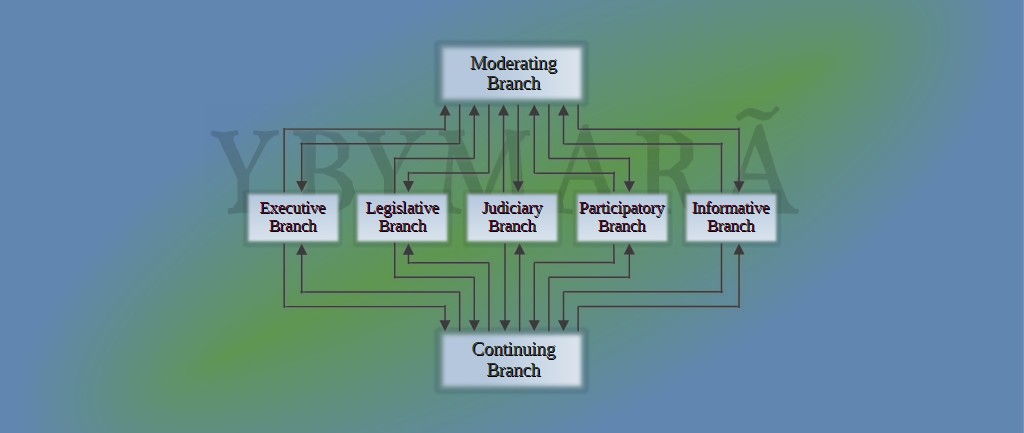
— Hypothetical Essays on the Heptapartition of Branches —
The concentration of power throughout human history has generated many distortions. It is very understandable that tyrannical leaders are fought and even deposed from power, but even if the holder of power is imbued with the best intentions, depending on the situation, things can become too complex for just one person to decide.
In this context, the tripartition of branches was very positive, decentralizing the countries’ management activities. Considering that tripartition was a significant advance, the following question arises: what if branches were divided even further?
The philosopher Montesquieu idealized the current tripartition of branches, despite its existence in ancient Greece. In addition to the three known branches, some countries also adopted the Moderating branch, which was attributed to the country’s sovereign and whose primary function would be to curb abuses.
The French thinker and politician Benjamin Constant devised a system with five branches, namely, the royal branch, the executive branch, the judicial branch, the branch representing continuity, and the branch representing opinion.
More recently, the idea that the media (in all its forms) has such a great influence on society has been accepted that it has come to be known as the Fourth Branch.
Drawing from these ideas, we can devise a seven-partitioned system of governance. The seven branches would be, Executive, Legislative, Judiciary, Moderator, Informative, Participatory and Continuing. Complementing the branches, there is the figure of the Supreme Council, composed of one member from each branch and which can be convened in the case of emergencies.
2. Brief description of the seven branches
Executive Branch – Has the function of governing through the execution of activities and services. The administration and registration of people, activities, and others is the responsibility of the informative and participatory branches. The moderating branch is responsible for the veto function, while the participatory branch is responsible for the sanction function. If necessary, the tiebreaker is the responsibility of the continuing branch.
Legislative Branch – Edits laws. Any and all laws, decrees, or government regulations must be approved by the legislative to be effective.
Judiciary Branch – Its objective is to guarantee individual, collective, and social rights while resolving conflicts between citizens and entities through petitions. When the issue involves the State, it is the participatory branch that will decide.
Moderating Branch – Can nullify any act of. It cannot modify or suggest anything, but it can nullify, totally or partially, the effects of any act of any other branch or company, not affecting individuals (these will be subject to the judiciary). It assumes the President’s veto power. It is made up of a group nominated by each of the other branches, say, three nominated by each branch, who will decide by vote. It takes on the responsibility of managing internal affairs and supervising other branches. This branch has no leader, requiring only the appointment of a supervisor to organize the presentation of facts and voting.
Informative Branch – Has the function of informing the people, companies, and other branches about the acts of all branches, companies, citizens, etc. This branch is responsible for determining which information should remain secret and which should become public. It is made up of leaders from strategic sectors and government. It is also responsible for Education, Research, and Science, as well as for recording social data, along with the Participatory Branch.
Participatory Branch – Its function is to propose, alter, or restrain any acts with the sole objective of collective well-being. It can intercede with other branches, propose laws and decrees (the executive no longer holds this role), and create or dissolve departments or companies, being the branch responsible for the registration and control of legal entities. It may also make a reanalysis of any existing rule of general interest and suggest changes to it. It is made up of a Permanent Popular Committee, with no predefined leader. A supervisor will be elected at each meeting.
Continuing Branch – It has the power to oversee and enforce the continuity of actions of any branch of government in any situation, especially when mandates change. In this regard, it is superior to the other branches. It is composed of an independent permanent commission, with no predefined leader, composed of members from the people, government, and business.
It is made up of one member from each power (there must be at least three nominees from each power, who can assume it without distinction, as there are no incumbents for this role). The Council is convened whenever an issue requires urgency, and its deliberations will be valid until the final pronouncement of the competent authority. It can be called by any of the powers or directors of institutions.
The Supreme Council can also be convened to resolve non-urgent issues, as long as they are of collective interest and the powers are in disagreement. In this case, your decision is permanent, as if it were an act of any other power.
There are no parties or elections in the seven-partitioned system. The leaders of each power are invested in the position through a selection process that takes into account positive evaluations from the community, the positions the candidate has held, and graduation diplomas.
The final selection of suitable candidates is made through objective tests. The subjective selection is made through evaluation by the community, which will grade the candidates.
There are three selection phases for public management and leadership positions.
In phase 1, candidates will undergo an assessment of the community in which they will work. Only candidates who obtain higher grades in this assessment will be considered eligible for the next phase. This phase is completely subjective; each citizen will have the right to provide a score from 1 to 5 to each candidate in the way that suits them best. The average will take into account the average of the grades and their quantity; that is, the more citizens give a rating, the higher the final score will be and vice versa.
Phase 2 will be applied to those who passed phase 1. Points will be awarded to those who have a degree and to those who have held a management position in companies or public offices. At this stage, points accumulated in previous administrations will also be computed.
Phase 3 will be the application of objective tests. Candidates who obtain the best grades from an average of phase 2 and phase 3 will be considered eligible. There will be no cut-off score, and the tiebreaker will be for the person with the highest grade in the objective test of phase 3.
Candidates who are invested in their respective positions will be regularly evaluated by the community, say, once a year, whose score will weigh on future applications. Assessment can also be adopted for any action the manager takes. The mandate should last four to six years, with the possibility of reinvestment.
